Texas Accessibility Standards Overview
Texas Code 501
Architectural Barriers Texas Accessibility Standards (TAS)CHAPTER 5: GENERAL SITE AND BUILDING ELEMENTS
501 General
501.1 Scope. The provisions of Chapter 5 shall apply where required by Chapter 2 or where referenced by a requirement in this document.
502 Parking Spaces
502.1 General. Car and van parking spaces shall comply with 502. Where parking spaces are marked with lines, width measurements of parking spaces and access aisles shall be made from the centerline of the markings.
EXCEPTION: Where parking spaces or access aisles are not adjacent to another parking space or access aisle, measurements shall be permitted to include the full width of the line defining the parking space or access aisle.
502.2 Vehicle Spaces. Car parking spaces shall be 96 inches (2440 mm) wide minimum and van parking spaces shall be 132 inches (3350 mm) wide minimum, shall be marked to define the width, and shall have an adjacent access aisle complying with 502.3.
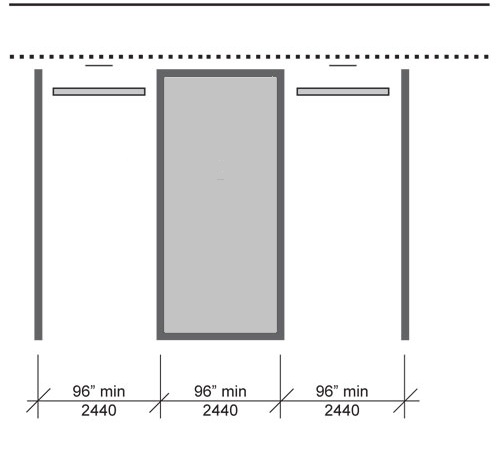
EXCEPTION: Van parking spaces shall be permitted to be 96 inches (2440 mm) wide minimum where the access aisle is 96 inches (2440 mm) wide minimum.

Figure 502.2 Vehicle Parking Spaces
502.3 Access Aisle. Access aisles serving parking spaces shall comply with 502.3. Access aisles shall adjoin an accessible route. Two parking spaces shall be permitted to share a common access aisle.
Advisory 502.3 Access Aisle. Accessible routes must connect parking spaces to accessible entrances. In parking facilities where the accessible route must cross vehicular traffic lanes, marked crossings enhance pedestrian safety, particularly for people using wheelchairs and other mobility aids. Where possible, it is preferable that the accessible route not pass behind parked vehicles.

Figure 502.3 Parking Space Access Aisle
502.3.1 Width. Access aisles serving car and van parking spaces shall be 60 inches (1525 mm) wide minimum.
502.3.2 Length. Access aisles shall extend the full length of the parking spaces they serve.
502.3.3 Marking. Access aisles shall be marked so as to discourage parking in them.
Advisory 502.3.3 Marking. The method and color of marking are not specified by these requirements but may be addressed by State or local laws or regulations. Because these requirements permit the van access aisle to be as wide as a parking space, it is important that the aisle be clearly marked.
502.3.4 Location. Access aisles shall not overlap the vehicular way. Access aisles shall be permitted to be placed on either side of the parking space except for angled van parking spaces which shall have access aisles located on the passenger side of the parking spaces.
Advisory 502.3.4 Location. Wheelchair lifts typically are installed on the passenger side of vans. Many drivers, especially those who operate vans, find it more difficult to back into parking spaces than to back out into comparatively unrestricted vehicular lanes. For this reason, where a van and car share an access aisle, consider locating the van space so that the access aisle is on the passenger side of the van space.
502.4 Floor or Ground Surfaces. Parking spaces and access aisles serving them shall comply with 302. Access aisles shall be at the same level as the parking spaces they serve. Changes in level are not permitted.
EXCEPTION: Slopes not steeper than 1:48 shall be permitted.
Advisory 502.4 Floor or Ground Surfaces. Access aisles are required to be nearly level in all directions to provide a surface for wheelchair transfer to and from vehicles. The exception allows sufficient slope for drainage. Built-up curb ramps are not permitted to project into access aisles and parking spaces because they would create slopes greater than 1:48.
502.5 Vertical Clearance. Parking spaces for vans and access aisles and vehicular routes serving them shall provide a vertical clearance of 98 inches (2490 mm) minimum.
Advisory 502.5 Vertical Clearance. Signs provided at entrances to parking facilities informing drivers of clearances and the location of van accessible parking spaces can provide useful customer assistance.
502.6 Identification. Parking space identification signs shall include the International Symbol of Accessibility complying with 703.7.2.1. Signs identifying van parking spaces shall contain the designation "van accessible." Signs shall be 60 inches (1525 mm) minimum above the finish floor or ground surface measured to the bottom of the sign.
Advisory 502.6 Identification. The required "van accessible" designation is intended to be informative, not restrictive, in identifying those spaces that are better suited for van use. Enforcement of motor vehicle laws, including parking privileges, is a local matter.
502.7 Relationship to Accessible Routes. Parking spaces and access aisles shall be designed so that cars and vans, when parked, cannot obstruct the required clear width of adjacent accessible routes.
Advisory 502.7 Relationship to Accessible Routes. Wheel stops are an effective way to prevent vehicle overhangs from reducing the clear width of accessible routes.
503 Passenger Loading Zones
503.1 General. Passenger loading zones shall comply with 503.
503.2 Vehicle Pull-Up Space. Passenger loading zones shall provide a vehicular pull-up space 96 inches (2440 mm) wide minimum and 20 feet (6100 mm) long minimum.
503.3 Access Aisle. Passenger loading zones shall provide access aisles complying with 503 adjacent to the vehicle pull-up space. Access aisles shall adjoin an accessible route and shall not overlap the vehicular way.
503.3.1 Width. Access aisles serving vehicle pull-up spaces shall be 60 inches (1525 mm) wide minimum.
503.3.2 Length. Access aisles shall extend the full length of the vehicle pull-up spaces they serve.
503.3.3 Marking. Access aisles shall be marked so as to discourage parking in them.

Figure 503.3 Passenger Loading Zone Access Aisle
503.4 Floor and Ground Surfaces. Vehicle pull-up spaces and access aisles serving them shall comply with 302. Access aisles shall be at the same level as the vehicle pull-up space they serve. Changes in level are not permitted.
EXCEPTION: Slopes not steeper than 1:48 shall be permitted.
503.5 Vertical Clearance. Vehicle pull-up spaces, access aisles serving them, and a vehicular route from an entrance to the passenger loading zone, and from the passenger loading zone to a vehicular exit shall provide a vertical clearance of 114 inches (2895 mm) minimum.
504 Stairways
504.1 General. Stairs shall comply with 504.
504.2 Treads and Risers. All steps on a flight of stairs shall have uniform riser heights and uniform tread depths. Risers shall be 4 inches (100 mm) high minimum and 7 inches (180 mm) high maximum. Treads shall be 11 inches (280 mm) deep minimum.
504.3 Open Risers. Open risers are not permitted.
504.4 Tread Surface. Stair treads shall comply with 302. Changes in level are not permitted.
EXCEPTION: Treads shall be permitted to have a slope not steeper than 1:48.
Advisory 504.4 Tread Surface. Consider providing visual contrast on tread nosings, or at the leading edges of treads without nosings, so that stair treads are more visible for people with low vision.
504.5 Nosings. The radius of curvature at the leading edge of the tread shall be 1/2 inch (13 mm) maximum. Nosings that project beyond risers shall have the underside of the leading edge curved or beveled. Risers shall be permitted to slope under the tread at an angle of 30 degrees maximum from vertical. The permitted projection of the nosing shall extend 1 1/2 inches (38 mm) maximum over the tread below.

Figure 504.5 Stair Nosings
504.6 Handrails. Stairs shall have handrails complying with 505.
504.7 Wet Conditions. Stair treads and landings subject to wet conditions shall be designed to prevent the accumulation of water.
505 Handrails
505.1 General. Handrails provided along walking surfaces complying with 403, required at ramps complying with 405, and required at stairs complying with 504 shall comply with 505.
Advisory 505.1 General. Handrails are required on ramp runs with a rise greater than 6 inches (150 mm) (see 405.8) and on certain stairways (see 504). Handrails are not required on walking surfaces with running slopes less than 1:20. However, handrails are required to comply with 505 when they are provided on walking surfaces with running slopes less than 1:20 (see 403.6). Sections 505.2, 505.3, and 505.10 do not apply to handrails provided on walking surfaces with running slopes less than 1:20 as these sections only reference requirements for ramps and stairs.
505.2 Where Required. Handrails shall be provided on both sides of stairs and ramps.
EXCEPTION: In assembly areas, handrails shall not be required on both sides of aisle ramps where a handrail is provided at either side or within the aisle width.
505.3 Continuity. Handrails shall be continuous within the full length of each stair flight or ramp run. Inside handrails on switchback or dogleg stairs and ramps shall be continuous between flights or runs.
EXCEPTION: In assembly areas, handrails on ramps shall not be required to be continuous in aisles serving seating.
505.4 Height. Top of gripping surfaces of handrails shall be 34 inches (865 mm) minimum and 38 inches (965 mm) maximum vertically above walking surfaces, stair nosings, and ramp surfaces. Handrails shall be at a consistent height above walking surfaces, stair nosings, and ramp surfaces.
Advisory 505.4 Height. The requirements for stair and ramp handrails in this document are for adults. When children are the principal users in a building or facility (e.g., elementary schools), a second set of handrails at an appropriate height can assist them and aid in preventing accidents. A maximum height of 28 inches (710 mm) measured to the top of the gripping surface from the ramp surface or stair nosing is recommended for handrails designed for children. Sufficient vertical clearance between upper and lower handrails, 9 inches (230 mm) minimum, should be provided to help prevent entrapment.

Figure 505.4 Handrail Height
505.5 Clearance. Clearance between handrail gripping surfaces and adjacent surfaces shall be 1 1/2 inches (38 mm) minimum.

Figure 505.5 Handrail Clearance
505.6 Gripping Surface. Handrail gripping surfaces shall be continuous along their length and shall not be obstructed along their tops or sides. The bottoms of handrail gripping surfaces shall not be obstructed for more than 20 percent of their length. Where provided, horizontal projections shall occur 1 1/2 inches (38 mm) minimum below the bottom of the handrail gripping surface.
EXCEPTIONS:
1. Where handrails are provided along walking surfaces with slopes not steeper than 1:20, the bottoms of handrail gripping surfaces shall be permitted to be obstructed along their entire length where they are integral to crash rails or bumper guards.
2. The distance between horizontal projections and the bottom of the gripping surface shall be permitted to be reduced by 1/8 inch (3.2 mm) for each 1/2 inch (13 mm) of additional handrail perimeter dimension that exceeds 4 inches (100 mm).
Advisory 505.6 Gripping Surface. People with disabilities, older people, and others benefit from continuous gripping surfaces that permit users to reach the fingers outward or downward to grasp the handrail, particularly as the user senses a loss of equilibrium or begins to fall.

Figure 505.6 Horizontal Projections Below Gripping Surface
505.7 Cross Section. Handrail gripping surfaces shall have a cross section complying with 505.7.1 or 505.7.2.
505.7.1 Circular Cross Section. Handrail gripping surfaces with a circular cross section shall have an outside diameter of 1 1/4 inches (32 mm) minimum and 2 inches (51 mm) maximum.
505.7.2 Non-Circular Cross Sections. Handrail gripping surfaces with a non-circular cross section shall have a perimeter dimension of 4 inches (100 mm) minimum and 6 1/4 inches (160 mm) maximum, and a cross-section dimension of 2 1/4 inches (57 mm) maximum.

Figure 505.7.2 Handrail Non-Circular Cross Section
505.8 Surfaces. Handrail gripping surfaces and any surfaces adjacent to them shall be free of sharp or abrasive elements and shall have rounded edges.
505.9 Fittings. Handrails shall not rotate within their fittings.
505.10 Handrail Extensions. Handrail gripping surfaces shall extend beyond and in the same direction of stair flights and ramp runs in accordance with 505.10.
EXCEPTIONS:
1. Extensions shall not be required for continuous handrails at the inside turn of switchback or dogleg stairs and ramps.
2. In assembly areas, extensions shall not be required for ramp handrails in aisles serving seating where the handrails are discontinuous to provide access to seating and to permit crossovers within aisles.
3. In alterations, full extensions of handrails shall not be required where such extensions would be hazardous due to plan configuration.
505.10.1 Top and Bottom Extension at Ramps. Ramp handrails shall extend horizontally above the landing for 12 inches (305 mm) minimum beyond the top and bottom of ramp runs. Extensions shall return to a wall, guard, or the landing surface, or shall be continuous to the handrail of an adjacent ramp run.

Figure 505.10.1 Top and Bottom Handrail Extension at Ramps
505.10.2 Top Extension at Stairs. At the top of a stair flight, handrails shall extend horizontally above the landing for 12 inches (305 mm) minimum beginning directly above the first riser nosing. Extensions shall return to a wall, guard, or the landing surface, or shall be continuous to the handrail of an adjacent stair flight.

Figure 505.10.2 Top Handrail Extension at Stairs
505.10.3 Bottom Extension at Stairs. At the bottom of a stair flight, handrails shall extend at the slope of the stair flight for a horizontal distance at least equal to one tread depth beyond the last riser nosing. Extension shall return to a wall, guard, or the landing surface, or shall be continuous to the handrail of an adjacent stair flight.

Figure 505.10.3 Bottom Handrail Extension at Stairs
ADA.gov
Accessible Parking Spaces
When state or local governments, businesses and non-profit organizations provide parking lots or garages, accessible parking spaces complying with the Americans with Disabilities Act (ADA) must be provided.
Accessible parking spaces are different than traditional parking spaces. They have specific features that make it easier for people with disabilities to access your programs, goods or services.
Topic
Read this to get a basic understanding of this topic.
- For more detailed information on a topic, view Guidance & Resource materials
- For information about the legal requirements, visit Law, Regulations & Standards
Features
Location
In parking lots or garages, accessible parking spaces must be located on the shortest accessible route to the accessible entrance. An accessible route is the path a person with a disability takes to enter and move through a building or facility.
Access Aisles
Accessible parking spaces must have access aisles. Access aisles provide a designated area for people who use wheelchairs or other mobility devices to get in and out of their car or van. Mobility devices allow people with disabilities to move about independently. They include walkers, canes, crutches, braces, manual or power wheelchairs, Segways, and electric scooters.
Access aisles must be:
- Marked (to discourage drivers from parking in them)
- The same length as the space
- Level with the parking space
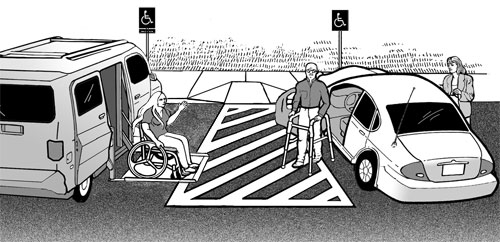
Two accessible parking spaces can share an access aisle with the access aisle between the two parking spaces (except in angled parking).
An access aisle can be placed on either side of the parking space (except in angled parking where it must be located on the passenger side of the parking space).
Parking Spaces
Accessible parking spaces must be provided for cars and vans.
Car accessible spaces must:
- Be at least 96 inches wide
- Have an access aisle at least 60 inches wide
- Have no more than a 1.48 (2.08%) slope in all directions
- Have a surface that is firm, stable, and slip-resistant
- Have a sign with the international symbol of accessibility on it, mounted at least 60 inches above the ground (measured to the bottom of the sign)
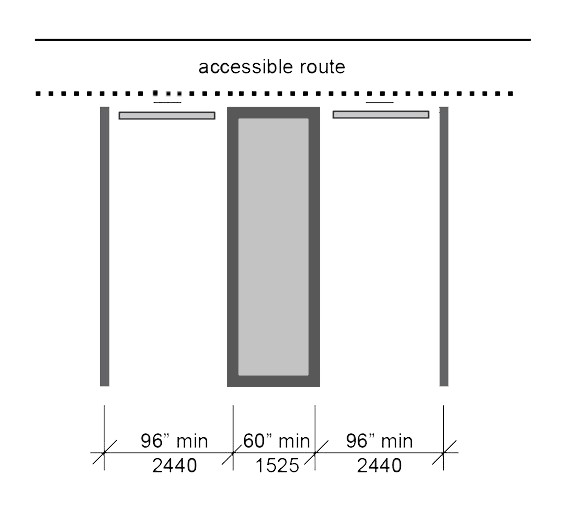
Van accessible spaces must (pick option #1 or #2)
Option #1
- Be at least 132 inches wide
- Have an access aisle at least 60 inches wide
- Have no more than a 1:48 (2.08%) slope in all directions
- Provide at least 98 inches of vertical clearance (van height) for the parking space, access aisle, and vehicular route
- Have a surface that is firm, stable, and slip-resistant
- Have two signs, mounted at least 60 inches above the ground (measured to the bottom of the sign)
- First sign: international symbol of accessibility
- Second sign: stating that the space is van accessible
Option #2
- Be at least 96 inches wide
- Have an access aisle at least 96 inches wide
- Have no more than a 1.49 (2.08%) slope in all directions
- Provide at least 98 inches of vertical clearance for the parking space, access aisle and vehicular route
- Have a surface that is firm, stable and slip-resistant
- Have two signs, mounted at least 60 inches above the ground (measured to the bottom of the sign)
- First sign: international symbol of accessibility
- Second sign: stating that the space is van accessible
Calculating Accessible Parking Spaces
The number of accessible parking spaces must be considered separately for each parking structure (lot or garage), not based on the total number of parking spaces provided on a site.
The chart below shows the number of accessible spaces required by the 2010 ADA Standards for Accessible Design.
Total Number of Parking Spaces Provided in a Parking Lot or FacilityMinimum Number of Accessible Parking Spaces Permitted1 to 25126 to 50251 to 75376 to 1004101 to 1505151 to 2006201 to 3007301 to 4008401 to 5009501 to 10002 percent of total1001 and over20, plus 1 for each 100, or fraction thereof, over 1000At least one of every six spaces must be van accessible.
Special Parking Conditions
Limited Parking
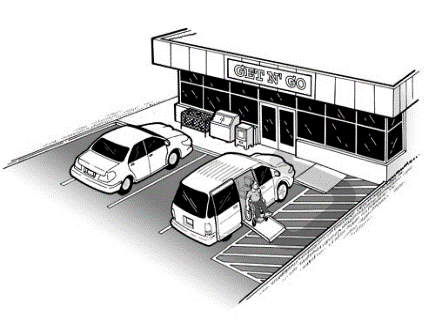
Where parking spaces are limited to four or fewer spaces:
- One van accessible parking space must be provided
- A sign identifying the accessible space is not required
Parking at Hospital Facilities
Hospital Outpatient Facilities
- Ten percent of patient and visitor parking must be accessible. At least one of every six accessible parking spaces must be van accessible.
Rehabilitation Facilities
- Twenty percent of patient and visitor parking must be accessible. At least one of every six accessible parking spaces must be van accessible.
Outpatient Physical Therapy Facilities
- Twenty percent of patient and visitor parking must be accessible. At least one of every six accessible parking spaces must be van accessible.